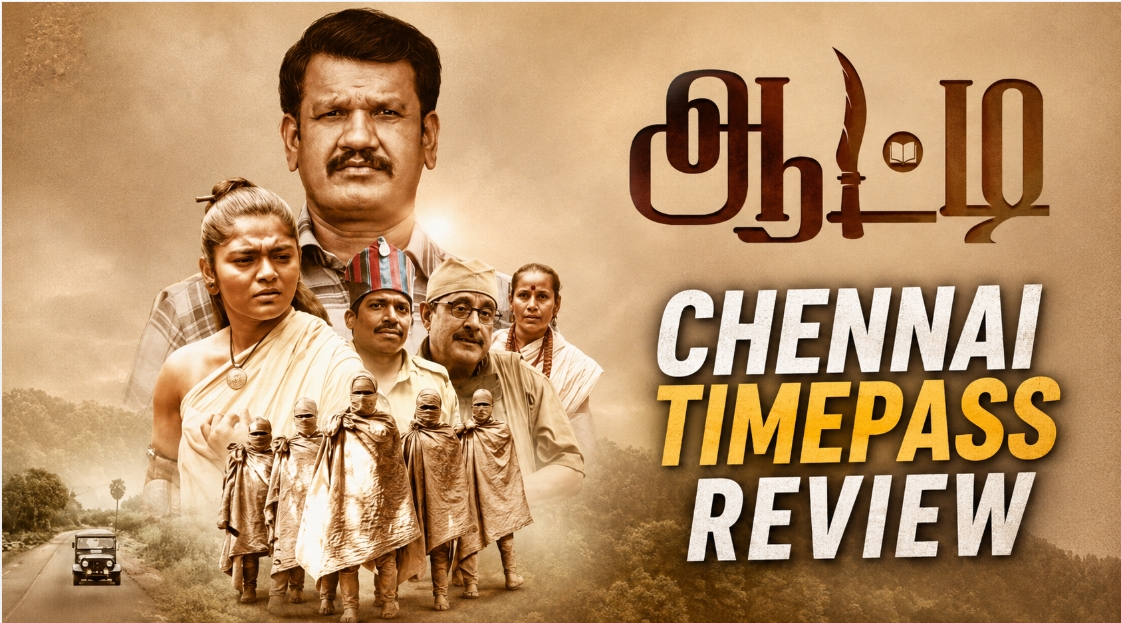
Aatti Movie Review
Introduction
Period crime thrillers often thrive on atmosphere, mystery, and compelling characters. Aatti, directed by T. Kittu, attempts to blend all three against the backdrop of the mist-covered tea estates near 1970s Madurai. Combining tribal folklore, murder investigation, and social commentary, the film creates an intriguing setup but struggles to maintain momentum once its most fascinating character exits the story.
What the Film Tries to Be
Set in a remote hill settlement, the film follows Amaithi Raj (Esakki Karvannan), a tough police inspector transferred to a quiet forest station, and Azhagu (Abi Nakshathra), the only educated woman in a tribal community who runs a school for local children.
The arrival of a new teacher, Selvam (Praveen Palanisamy), disrupts the peaceful environment. His predatory behavior quickly makes him a target of suspicion, and when he is found dead under mysterious circumstances, Amaithi Raj is assigned to investigate.
What begins as a promising murder mystery soon evolves into a crime drama intertwined with local legends and political pressure from influential figures in Madurai.
Narrative Structure – Where It Falters
The film starts strongly by establishing its setting, characters, and underlying tensions. Selvam emerges as the most dynamic presence in the story, creating immediate conflict and unpredictability.
However, once the murder occurs, Aatti loses much of its dramatic energy. The investigation becomes more focused on explaining events than generating suspense. Instead of deepening the mystery, the screenplay gradually shifts into procedural mode, reducing the emotional and narrative stakes.
Amaithi Raj remains a competent investigator, but his character lacks the complexity needed to carry the film entirely on his shoulders. Similarly, Azhagu often functions as an observer rather than an active force driving the narrative forward.
As a result, the second half never fully recaptures the intrigue established during the opening portions.
Character Utilisation
Abi Nakshathra
Abi Nakshathra delivers a restrained and convincing performance. She effectively portrays Azhagu’s strength and dignity, though the screenplay doesn’t provide enough opportunities for the character to influence the story significantly.
Esakki Karvannan
Esakki Karvannan offers a steady and believable performance as Inspector Amaithi Raj. His screen presence helps maintain engagement even when the narrative slows down.
Praveen Palanisamy
Praveen Palanisamy leaves the strongest impression among the cast. Despite limited screen time, he creates a memorable antagonist whose presence drives much of the film’s initial tension. Ironically, the film suffers after removing its most compelling character too early.
Visual & Technical Merits
Cinematography
Cinematographer Sibi Sadhasivam captures the misty tea estates and dense forest landscapes beautifully. The visuals create a convincing period atmosphere and add considerable value to the storytelling.
Background Score
The score frequently attempts to build suspense and dread, but the visuals and narrative rarely match the intensity suggested by the music. While technically competent, the soundtrack often promises more tension than the screenplay delivers.
Production Design
The recreation of the 1970s setting is handled effectively. Costumes, locations, and overall visual detailing contribute to the film’s authenticity.
Theme vs Execution
One of the film’s most intriguing elements is its folklore surrounding a group of vigilante women who were betrayed and beheaded in the 1880s, with legends claiming their spirits still roam the forest.
Unfortunately, this mythology remains largely informational rather than experiential. The audience hears about the legend more than they actually feel its impact. The supernatural undertones never develop into a truly haunting presence, leaving a potentially powerful theme underexplored.
The film’s social commentary and historical backdrop offer depth, but the execution rarely elevates these ideas into something emotionally memorable.
Plus Points
✅ Beautiful cinematography and atmospheric locations
✅ Strong period setting and production design
✅ Good performances from Abi Nakshathra and Esakki Karvannan
✅ Praveen Palanisamy delivers an effective antagonist
✅ Tight runtime that avoids unnecessary dragging
✅ Interesting folklore and mystery setup
Minus Points
❌ Loses momentum after the villain’s early exit
❌ Investigation lacks sustained suspense
❌ Azhagu remains underutilized as a character
❌ Folklore elements feel underdeveloped
❌ Background score creates tension the screenplay rarely delivers
❌ Mystery becomes predictable in the latter half
Final Verdict
Aatti is a technically sound period crime drama that benefits from strong visuals, committed performances, and an intriguing premise. Unfortunately, the film loses its most compelling source of tension too early and never fully recovers.
While the atmosphere and craftsmanship remain impressive, the screenplay struggles to generate enough suspense or emotional investment to make the mystery truly gripping. What remains is a respectable effort that is watchable and professionally made, but ultimately less engaging than its setup promises.
⭐⭐⭐☆☆ 2.75 / 5
“A visually appealing period crime drama with an intriguing mystery, but one that loses its strongest character too early and never quite regains its momentum.” 🌿🔍⚖️
 suresh